Ice storms are how a lot of Northland trees actually fail — not only the spring thunderstorms people watch on radar. A glaze event loads every branch at once. Weak-wooded trees come apart first. If you are looking at hanging limbs in Liberty, a split maple in Gladstone, or a tree across a drive in Kearney or Smithville, start with safety, then documentation, then a professional. Call (816) 837-4103 when you are ready to request emergency tree service.
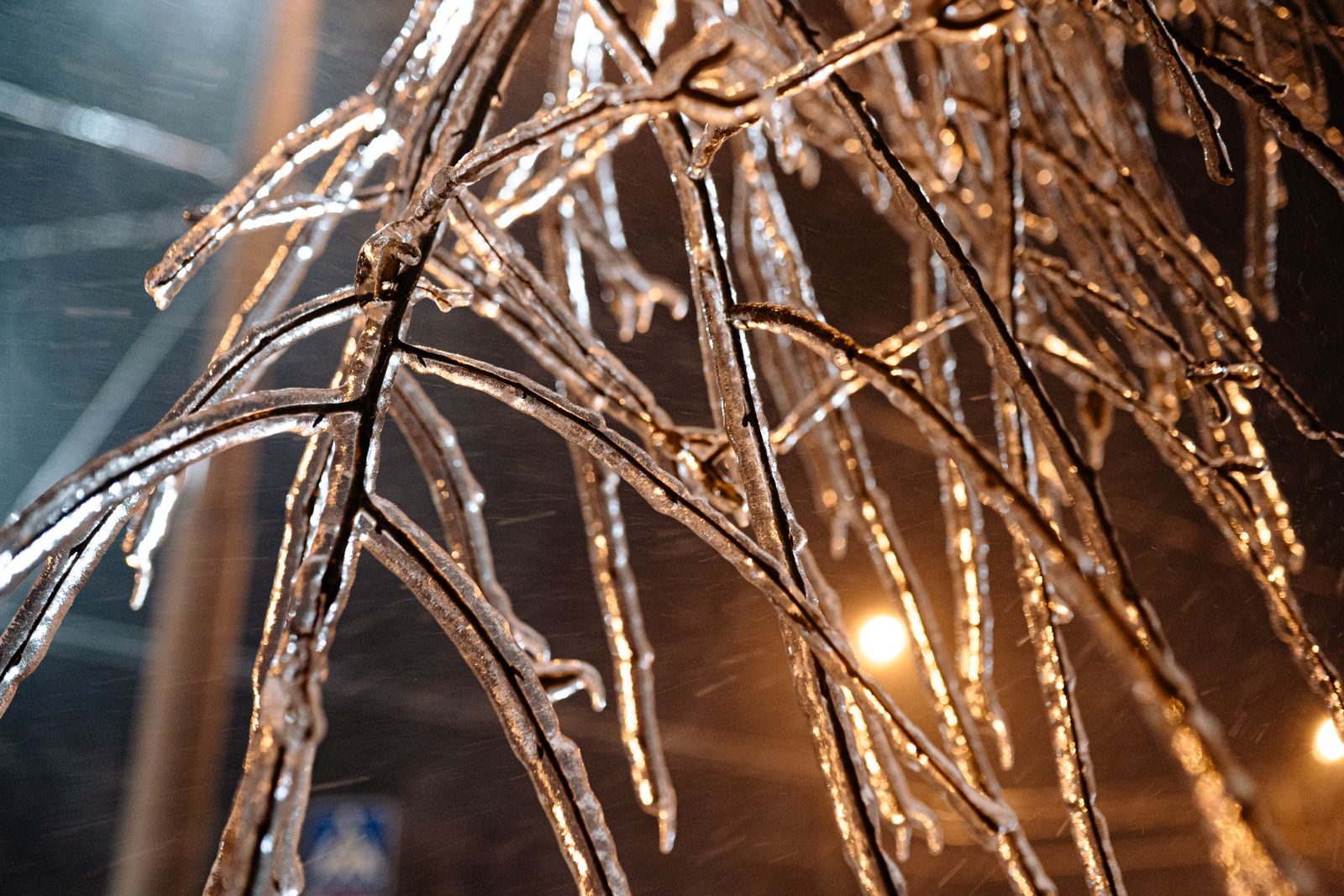
First: do not make it worse
- Stay back from hanging limbs and trees that have split but not finished falling. The next drop can happen without more ice.
- If a line is down or a tree is on a line, do not approach it. Call the utility or 911. Tree work starts after the utility says the site is safe.
- Do not climb a ladder with a chainsaw to “take a little weight off.” Branches under ice and tension spring unpredictably.
- Keep kids, pets, and cars out of the fall zone, including the neighbor’s side if the tree is leaning that way.
It is reasonable to walk the property from a safe distance, once, to see whether a door, driveway, or bedroom wall is at risk. It is not reasonable to start cutting.
Which trees usually break here
Kansas City-area horticulture writing after past ice and heavy-snow events has pointed to silver maple, ash, ornamental pear, river birch, redbud, and some red maples as frequent failures. They grow quickly or have tight branch unions, and the wood does not carry ice as well as slower, denser hardwoods.
Pin oaks and bur oaks generally hold up better, which is why you will sometimes see an oak street almost untouched next to a maple that lost a third of its crown. That does not make an oak immortal. A decayed union or a root plate that lifted in saturated soil can still fail.
Green and white ash have a second problem. Emerald ash borer was confirmed in Platte County in 2012 (including a find near Parkville) and detected in Clay County in 2014. An ash that was already hollow can look intact under ice until it doesn’t.
If you are replanting later, look at a current Kansas City recommended-tree list (K-State Research and Extension has one) rather than putting another silver maple or Bradford-type pear in the same spot.
Document the damage for insurance
From a safe place, take wide photos that show the tree, the house or car, and the ice or debris. Then closer photos of the point of failure, if you can get them without walking under the canopy. Do not move anything until you have those shots, unless you have to clear a path out of the house.
Call your insurance company when a structure or vehicle is involved. Policies often treat a tree that damages a building differently from a tree that falls only in the yard. We are not insurance advisors; your carrier’s language controls. Keep the written estimate you get from a tree professional. Ask them to separate “make it safe now” from full cleanup and stump grinding if you need to make decisions with an adjuster.
What to tell us when you call
Call (816) 837-4103 or use the contact form and say “ice storm” plus:
- Your city
- Whether the tree is on a house, garage, car, or only in the yard
- Whether the driveway is blocked
- Whether any line is involved
- Photos, if you can send them safely
After a widespread Northland ice event, response times stretch. A hanging limb over a front door will be treated as more urgent than a tree already on the ground in an open side yard. That triage is appropriate.
A crew may make the site safe and come back when the ice melts. Working lifts and ladders on glaze ice is a good way for a second accident to happen.
After the ice melts
Walk the yard again. Some splits only become obvious when the canopy stands back up. Dead hanging wood can stay in a tree for months. That is scheduled trimming or removal, not necessarily a midnight emergency, but it should not be ignored until the next storm.
If several trees failed on a larger Smithville or Platte City lot, you may also be looking at a cleanup or lot clearing scope. Define “done” before you accept a bid: wood piled, wood hauled, stumps ground, or just a path opened.
Short checklist
- Stay away from lines and hanging limbs.
- Photograph damage from a safe distance.
- Call the utility if a line is involved; call your insurer if a structure is hit.
- Call (816) 837-4103 for a local professional to make the tree safe.
- Schedule leftover deadwood and stumps once the emergency work is finished.
Tree services are provided by independent local tree professionals. Price ranges are general estimates, not quotes.